

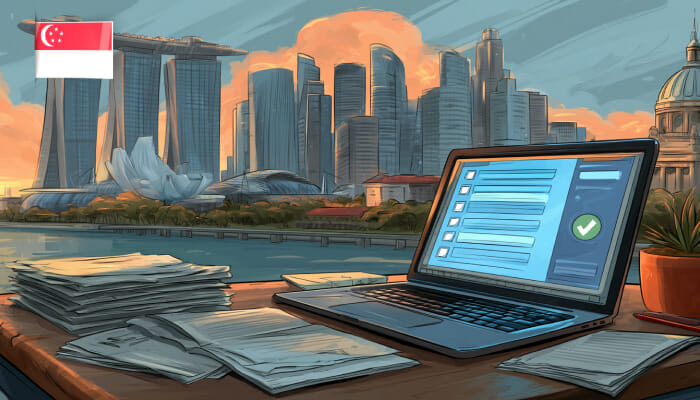
Founders who want operational flexibility inside a transparent legal system keep arriving at one option: they open a sole proprietorship in Singapore. Investors and other market participants treat the format as a practical route for testing a niche across Asia-Pacific markets.
Set against the regulator’s current rulebook, this guide lays out how the single-owner route plays out on the island. You will see what Sole Proprietorship status actually carries: a business with no legal identity of its own, full liability landing on the founder, and the particular conditions foreign applicants have to satisfy.
Legal Nature of a Sole Proprietorship: What the Status Means
The idea of a one-person business is familiar the world over, yet the city-state files it under a legal category of its own. So before you open a sole proprietorship in Singapore, study the commercial format the law relies on here: the Sole Proprietorship. It puts one-person trading on a legal footing and adds no complex management layer.
Everything is filed on Bizfile, the online system ACRA runs, and each single-owner venture is set up there. Intend to trade under a distinct commercial name, and that name has to be reserved beforehand. Stick to your own full legal name, and the Business Names Registration Act 2014 may spare you the reservation altogether.
A sole proprietorship in Singapore never acquires a legal identity of its own; in the eyes of the law, the trader and the venture are legally fused. Any debt or obligation the activity generates is therefore met from the founder’s own funds, not from a ring-fenced corporate pool. Day-to-day running stays uncomplicated, but the founder’s own property sits on the line.
That open-ended exposure is the model’s defining financial hazard. Nothing places a ceiling on a creditor’s claim, so legal claims or unpaid debts can cut directly into the founder’s personal estate and savings.
The format earns its keep in a fairly narrow band of work:
- freelance design and programming;
- everyday services for private clients;
- small retail outlets and local trade;
- advisory and expert consulting work;
- trial runs of new commercial niches.
Much of the appeal comes down to light yearly administration: no mandatory audit, no qualified secretary to keep on the payroll. It suits ventures where the founder’s personal input counts for more than sheer trading volume.
Anyone setting up locally should size up the growth ceiling from day one. Because the format issues no shares, outside equity has no way in; scaling into bigger projects means winding the format down and setting up a full company in its place.
Sole Proprietorship or Pte Ltd: Which Structure Fits
Founders stepping into an international market usually compare a few ways to formalize, and the shortlist tends to come down to two: sole ownership, or a closed private limited company (Pte Ltd). At its heart, the difference between a sole proprietorship and a company in Singapore turns on two questions: how well personal capital stays protected, and how much administrative load the owner carries.
What pulls independent professionals toward the sole-trader route is mostly the price tag: the state charges only S$115 for the opening year. Incorporating costs visibly more, both to launch and to keep running each year.
Where the gap opens widest is sole proprietor liability in Singapore: a claim against a one-person trader runs without any upper limit. Incorporate instead, and that hazard is walled off inside the paid-in share capital, and it is precisely that wall between the founder’s money and the firm’s money that makes the company route the steadier bet for trading.
Sole Proprietorship set beside a Pte Ltd:
|
Criterion |
Sole Proprietorship |
Pte Ltd |
|
Standing in law |
Fused with its owner |
A legal person in its own right |
|
If debts pile up |
You answer for everything, without limit |
Exposure stops at what you put in |
|
Who the tax lands on |
The proprietor personally |
The company as a taxpayer |
|
Rate applied |
Climbs with income to a 24% cap |
Held flat at 17% |
|
Day-to-day control |
One owner steers it, lightly |
Bound by formal governance |
|
Company secretary |
Not part of the setup |
Must be appointed |
|
Passing it on |
Cumbersome, with contracts redrawn |
A matter of transferring shares |
|
Raising outside money |
An uphill climb |
Built for it |
|
Best-fit work |
Solo trades, small shops, plain services |
Growth plays, partnerships, licensed lines |
Reporting rules pull the two apart too. A company settles a flat 17% corporate tax, while a single-owner’s profit runs through the progressive personal income scale, peaking at 24% for resident individuals, worth weighing before you settle on the simpler format.
The same light-touch design brings further advantages: no board minutes to write up, no financial statements to lodge with regulators. All the owner keeps is clean records of income and outgoings for the tax office, whereas companies file prescribed returns every year.
Large overseas counterparties, though, tend to approach the single-owner model with caution. Banks extend a credit line more readily to an incorporated body they trust, and investors, for their part, would rather deal with share capital.
Who Qualifies: Conditions for Local and Foreign Founders
The first gate on who can open a sole proprietorship in Singapore is age: an applicant has to have reached majority. Past that, local law lets anyone with the necessary legal capacity establish a commercial structure, provided no court-ordered ban stands against them.
Locals and PR holders clear one further hurdle up front, linked to the compulsory savings everyone pays into the national pension scheme. No filing is accepted until the applicant’s MediSave account is shown to be free of arrears.
Founders without residency take a wholly separate path. Rather than lodging that opening application on Bizfile in person, they route it through an accredited corporate registrar; lacking resident status, they simply cannot use the self-service door.
On top of that, a non-resident must appoint an authorised representative, a local agent settled in the country on a permanent basis. This agent serves as the primary interface for government authorities and answers for compliance with local rules.
Eligibility for the owner of a Sole Proprietorship in Singapore:
|
Applicant category |
Core rule |
Extra conditions |
|
Singapore citizen |
At least 18 |
MediSave verified at sign-up and again at renewal |
|
Permanent resident |
At least 18 |
No current restriction on running a business |
|
Non-resident foreigner |
Files through a Corporate Service Provider (CSP) |
Local agent required once every owner is offshore |
Business registration stands completely apart from immigration law and grants no automatic right to remain. An entrepreneur who intends to work on the ground still needs a separate work pass from the Ministry of Manpower alongside the registration itself. The dedicated EntrePass track is aimed mainly at limited-liability companies, not sole proprietorships.
Undischarged bankruptcy is an outright bar: the rules keep anyone in that situation from directing business operations.
A final cluster of conditions closes the list. The business must hold a local office, and the applicant picks an industry identifier from the SSIC register. Sign-off on the filing depends on the name review, and wording that touches finance, healthcare or education is off-limits in the trading name.
Steps to Register a Sole Proprietorship in Singapore
The answer to how to open a sole proprietorship in Singapore runs through ACRA’s Bizfile procedure, and from the outside it can look brief, since the main actions happen online. Speed is not the whole story, though: legal soundness rests on several variables, the name, the activity code, the owner’s status, the address, a local agent for foreigners, and any licenses the activity triggers where the field is regulated.
It starts with a proposed name filed on ACRA Bizfile; the filing costs S$15, and an approved name holds its reservation for a 120-day window. Where the name uses regulated wording or hints at activity a sector regulator supervises, ACRA routes the file for extra review.
Setting up the entity involves choosing an SSIC code and entering it on the filing; because that number encodes the principal commercial activity, it tells government agencies what the business really does. Choose the wrong one and you invite added scrutiny from licensing bodies and banks.
The submission must set out the founder’s particulars, the trading address, an email, the start date and, where it is needed, a local agent. A founder based offshore files by way of a CSP; should every owner reside overseas, the paperwork has to name a locally resident agent.
The registration charge is S$100 for a single year, or S$160 across a three-year term once the CPF Board’s conditions are satisfied. The moment the record lands, the venture is assigned a UEN, the number it cites thereafter to state agencies, banks and trading partners.
The steps to register a sole proprietorship in Singapore do not stop at the UEN. Next comes Corppass, which unlocks government e-services, followed by a Business Profile, a license check on GoBusiness Singapore, and an accounting setup geared for tax reporting.
Founders arranging all this from abroad hit one added complication: the corporate and immigration workstreams have to move in step. Owning the business from overseas is perfectly allowed; using that ownership alone to trade on the ground here is not. Running operations on the ground means a separate check against the Ministry of Manpower’s rules and a qualifying residence status.
License screening usually follows straight after the corporate step and runs on its own track: ACRA registers the business, but the permits stay with sector regulators. Food service needs clearance from the Singapore Food Agency, real estate work reports to the Council for Estate Agencies, financial services sit under the MAS, and education ventures go to whichever agency fits the teaching format chosen.



Timeline, Cost, and Renewal for Sole Proprietorship Registration in Singapore
Budgeting starts with the mandatory government fees. The opening payment to ACRA goes to name reservation; from there the entrepreneur chooses how long the status should run, with a one-year term carrying a S$100 registration fee.
Sign up for a twelve-month spell and the bill lands at S$115. Push the term out to three years and the registration line itself drops to S$160; fold in the name charge, and the full cost of registering a sole proprietorship in Singapore over the longer term reaches S$175.
Government fees, though, are only part of the picture. A foreign founder’s budget also has to absorb a professional registrar’s fee and a local agent, and for non-residents those two lines account for the bulk of the launch spend.
Government fees at a glance, registration and renewal:
|
Action |
Fee (S$) |
|
Name application |
15 |
|
Registering for one year |
100 |
|
Registering for three years |
160 |
|
One-year setup, all in |
115 |
|
Three-year setup, all in |
175 |
|
Renewing, one year |
30 |
|
Renewing, three years |
90 |
|
Overdue filing, under 3 months |
50 |
|
Overdue filing, past 3 months |
200 |
Turnaround normally runs between one and three working days, and the automated system clears most submissions the moment payment settles. A sensitive word in the name changes that picture: the file is handed to the relevant ministries, where a verdict can take anywhere from fifteen to sixty working days.
A reserved name holds for a 120-day window, and every formal step has to be completed inside that window. A timely renewal of a sole proprietorship in Singapore opens two months before the current term lapses, and the three-year cycle adds one condition: social contributions must be fully paid up.
Filing late draws administrative penalties: S$50 when the delay stays under three months, climbing to S$200 once it runs longer. Miss the deadline outright and cancellation is automatic; the business is struck off sixty days after the lawful period lapses.
Tax Obligations for a Sole Proprietorship in Singapore
Taxes for sole proprietors in Singapore follow an altogether different logic from company tax. Because the venture carries no legal identity apart from its founder, there is nothing standing there to be taxed on its own; whatever it earns flows through to the proprietor as private income, rolled into that person’s wider personal total and booked on the IRAS register as self-employment income.
The bill a one-person venture faces turns largely on the owner’s status. A tax resident is assessed on the graduated personal scale: the opening S$20,000 of chargeable income is free of tax, the following S$10,000 is charged at 2%, the S$10,000 beyond that at 3.5%, and anything past S$1,000,000 at the ceiling rate of 24%. A non-resident is handled under separate rules, shifting with the nature of the income, where it springs from, and how the work is put together.
Once certain thresholds are passed, the rules on income tax in Singapore make a return compulsory for the self-employed: total revenue of S$22,000 across twelve months sets off that duty, as does net profit above S$6,000. Foreign persons earning from local assets are held to the same obligation and must record those receipts with the authorities all the same.
Bookkeeping has to be ready before the very first transaction goes through. IRAS looks for an accurate record of every transaction, with source documents held on file for five full years.
Those records take in agreements, invoices, receipts and bank statements, together with production costs, the basis for any relief claimed, and paperwork on counterparty payments.
The tax picture for a one-owner business, condensed:
|
Parameter |
Official figure |
|
Return due once yearly income tops |
S$22,000 |
|
Or once net self-employed profit tops |
S$6,000 |
|
Keep records for |
five years, minimum |
|
Revenue to S$200,000, report as |
2-line statement |
|
Revenue over S$200,000, report as |
4-line statement |
|
Upload certified accounts from |
S$500,000 yearly revenue |
|
GST sign-up once turnover exceeds |
S$1,000,000 |
|
GST rate |
9% |
|
Resident’s top personal rate |
24% |
The reporting format follows revenue size. Up to and including S$200,000, a 2-line statement does the job, revenue plus adjusted profit or loss. Above that mark, a 4-line statement takes over, covering revenue, gross profit or loss, allowable deductions, and adjusted profit or loss.
GST belongs on that watch list as well. Once turnover reaches S$1,000,000 in a reporting period, registration for this indirect tax becomes unavoidable, and merely forecasting that the threshold will be passed in the year ahead brings the same obligation. The rate stands at 9% at present.
For residents, MediSave is wired straight into the workflow: once profit clears S$6,000, mandatory top-ups into the insurance balance inside the CPF scheme become due. These payments are no optional extra; they sit at the heart of the entrepreneur’s social safety net.
Conclusion
For ventures built around a fast operational start, opening a sole proprietorship in Singapore pays off: entry barriers stay low and reporting stays light. The risks still deserve attention, chief among them uncapped personal liability, along with the special conditions placed on foreign participants.
 Obtaining a Fintech license in Singapore in 2026
  Obtaining an SPI license + registration of a payment institution in Singapore
  Electronic money license in Singapore in 2026
  Singapore: obtaining a Forex Broker License
  Obtaining a gambling license in Singapore